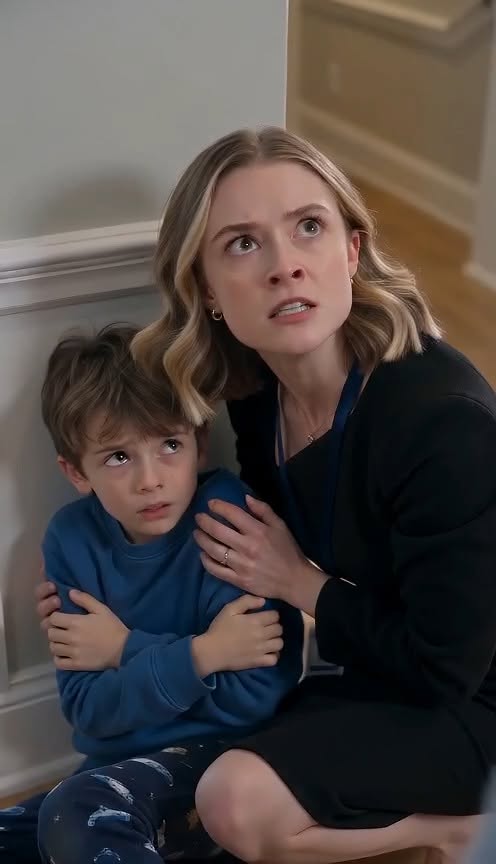
I almost didn’t turn the key.
That is the part I keep leaving out when I tell this at work, in the hallway outside interview rooms, in the voice I use when I need other adults to believe I am made of procedure. I almost sat in the driveway with the engine running and the lanyard still twisted from the seatbelt and told myself that a foyer is only a foyer, that a broom handle is only a broom handle, that a grown man raising his voice in his parents’ house is a family matter and not a file.
My name is Rachel Morgan. I am thirty-four. I wear a black dress to offices that pretend black is neutral. I wear a navy lanyard because the badge has to be visible. I wear a gold heart on a thin chain because my mother gave it to me the year I said I would not do this job forever, and then I did it forever anyway. Grant Hale is thirty-two. Grey sweater. Dark pants. The kind of haircut that photographs well at holidays. Margaret and Arthur live in the house with the oak stairs and the white banister and the glass door with the pretty sidelights, and they drink coffee at hours when coffee is supposed to be comfort.
I need you to hear the correction before the rest of this becomes the story people prefer to share.
There was no boy on that hardwood.
There was a porcelain doll.
I am saying it plainly because the mind is a factory for pulse. It sees a blue sweatshirt and space-print pajama pants and white socks and a painted face tucked into painted arms, and it supplies a spine. It hears me shout don’t touch him and it supplies a son. I shouted it. I will not unshout it. The figure on the floor was a boy-sized hyper-realistic porcelain articulated doll with brown sculpted hair and a frightened expression a craftsman had been paid to make permanent. It was posed curled against the wall. It was cold when I put my coat around it. It had the weight of an object that wants to be mistaken.
And still I dropped my bag.
Still I went to my knees on someone else’s floor as if my job description had been rewritten by the sound of wood hitting wood.
I had a visit on the calendar. That is the boring truth underneath the cinematic one. A follow-up. A conversation about a household that kept using the word discipline like a synonym for volume. Grant’s other address was already a paragraph in a report I was not supposed to quote on Facebook. I am quoting my own body instead. My body heard the bang from the porch.
Bụp.
Bang.
Not a door.
Not a dropped pan.
The specific pop of a wooden handle finding a banister that was never built to be a lesson.
I opened the glass door on a scene the house had already framed. Grant on the lower stairs, arms still in the follow-through of a swing. The broom handle—not a bat, I keep insisting on the ordinary word—rebounding off white painted wood. The doll on the floor in that curled pose. A glass tipping off the stair ledge. A dark-red splash blooming on the hardwood.
Wine.
I need that word nailed down like a notice on a clinic wall. Spilled red wine. Fruit and tannin. Not the other stain people will type in the comments to make themselves feel like detectives. There was no glass still in Grant’s hand. There was only the color, small and vivid, as if the house had signed the moment in the only ink it had.
Grant’s face was the face of a man who had meant to hit something that could learn.
The handle had missed the doll.
I saw the miss the way you see a car that almost reaches a body and then kisses a railing instead. The air where contact would have been was still shaking. The banister had taken the sentence for the porcelain.
I said the sentence anyway.
“Don’t touch him.”
Him.
The pronoun came out of the part of me that has sat on too many carpets and used first names like tourniquets. The doll did not flinch. Porcelain does not flinch. My arms went around it because my training and my superstition are not as separate as my supervisor hopes.
Grant looked at me as if I had walked into a private religion.
I stood up faster than dignity recommends. The coat slid. The lanyard bounced against the heart necklace. My palm went toward his face in a line I have written reports against. I will not dress that up as choreography. It was a tát trượt, a glancing slap, more sound than square contact. The camera I do not own would have cut to his cheek at the noise.
Slap.
Bụp.
He touched the place my hand had grazed and he smiled.
That smile is the reason I am writing past the length a caption is supposed to be. Anger I can file. Fear I can file. A man smiling after being caught mid-swing, in his parents’ foyer, with wine on the floor and a doll at his feet, is a different species of information.
“I disciplined him,” Grant said. “I disciplined him.”
Twice, as if repetition could turn a broom handle into a philosophy.
Margaret was in the hallway by then with the mug. Arthur behind him in the light-blue shirt. They had the expressions of people who had heard the first bang and chosen the extra three seconds of coffee. I do not know if that is fair. Fairness is a luxury I did not bring through the sidelights.
“He needed to learn,” Grant said.
Learn.
I looked down at the doll. The painted eyelids. The space rockets on the pajama pants. The white socks that had never run anywhere. I thought of the other household Grant still had access to, the one with a living schedule and a school form and a name I will not type here because this is already closer to a file than a post.
I pointed at him.
One finger. The gesture people mock until they are standing inside it.
“Touch my son again,” I said, “and I’ll make sure you never get near your other household again.”
Son.
There it was a second time. The word that makes this story dangerous to tell and impossible not to tell. I was not his mother. The doll was not a child. The sentence was a bridge I built in real time between the object on the floor and the living rooms I am paid to imagine before they become hallways like this one.
Grant’s broom handle stayed down.
Margaret’s mug stopped halfway to her mouth.
Arthur said my name like a question that wanted to be a rebuke.
I did not look at Arthur. I looked at the wine stain until it stopped being a color and became a clock.
If you want the fifteen seconds, you already have them. Door. Swing. Miss. Banister. Bag. Knees. Pronoun. Glancing slap. Smirk. Discipline. Learn. Finger. Freeze.
If you want the rest, you will have to walk the house with me after the pointing was over.
Grant laughed under his breath, the little laugh of a man who has been told he is intense and has decided intense is a compliment.
“It’s a doll, Rachel.”
“Then why did you swing at it.”
“I swung at the stairs.”
“The stairs did not curl up.”
He glanced at Doll A as if noticing the pose for the first time and finding it inconvenient. “Margaret puts it there. She thinks it makes the landing look lived in.”
Margaret’s voice came thin. “I didn’t put it like that.”
Arthur said, “Everyone needs to calm down.”
Calm down is the most expensive sentence in a foyer. It costs whoever is on the floor.
I kept my body between Grant and the doll. My heel had come half out of the shoe. The ID badge kept turning itself backward, which felt like a joke the universe did not have time for.
“Put the handle down,” I said.
“It’s a broom.”
“Put it down.”
He set it against the banister with a care that was almost mockery. The wood left a faint scuff on the white paint, a comma after the bang.
I took out my phone.
Grant’s smile thinned. “You can’t record in my parents’ house.”
“I can write what I saw,” I said. “The recording is a courtesy you should hope I use.”
I did not start a new video. I opened the one that was already there.
That is the part my supervisor will hate me putting on the internet. There had been a nanny cam conversation two visits ago. Margaret had said they used it for packages. Arthur had said they used it because the neighborhood had changed. Grant had said he had nothing to hide. I had asked them to keep the files. I had not expected the file to be waiting in my email like a tooth.
Timestamp: twenty-two minutes before I touched the door.
Grant in the grey sweater. The broom handle. The doll not yet on the floor but seated on the second stair, upright, facing him. His voice on the clip was almost tender at first, which is worse.
“You don’t listen.”
Then the lift of the handle.
Then Margaret offscreen saying Grant.
Then the swing that, on video, also missed and found the banister, as if even his violence had a talent for nearly.
I turned the screen.
Arthur went pale in a way coffee cannot repair.
Margaret said, “He was upset about the other house.”
“The other house is not a reason to rehearse on porcelain,” I said.
Grant pointed at the doll. “You people put ideas in the air and then you act shocked when a man tries to keep order.”
“Order,” I said. “Is that what the wine is.”
He looked at the stain as if it had betrayed him by being visible.
“I knocked a glass,” he said.
“You knocked a glass because you needed a prop for the story where you almost didn’t.”
We stood in the composition the house had chosen. Me in black, finger still mentally raised. Grant with his cheek pink from the glance he would later call an assault. The doll against the wall. The grandparents in the mouth of the hall. Daylight from the sidelights making everything look too clean for the sound that had lived here.
I knelt again.
I hate kneeling in other people’s houses. It rearranges power and then pretends it didn’t. I checked the doll the way I have checked living arms, because muscle memory does not respect materials. No new crack I could see. A hairline at the wrist that might have been old. The painted tear on the cheek was factory-made. My coat button had left a tiny pressure mark on the sweatshirt fabric.
“Rachel,” Margaret said. “It’s only a figure.”
“Then let me take it.”
Silence.
Arthur: “It belongs to the house.”
Grant: “You’re not taking anything.”
I looked at Margaret until she had to look at the doll.
“You posed it,” I said softly. “Or it was posed. Either way, someone in this foyer wanted a body on the floor before I arrived.”
Margaret’s mouth shook. “I heard him start. I came down. I didn’t want the landing empty. Empty landings make him louder.”
That sentence will live in my notes until I retire or until the notes outlive me.
Empty landings make him louder.
I asked Grant about the other household. He told me I was obsessed. I told him obsession is what we call attention when it arrives without an invitation. He told me his other kid—his word—needed a father who didn’t get soft because a woman with a badge walked in. I told him softness was not the opposite of a broom handle. The opposite of a broom handle is a hand that stays at a man’s side.
He touched his cheek again, theatrical.
“You hit me.”
“I missed you,” I said. “The way you missed that doll. The difference is I am glad I missed.”
Arthur actually flinched at glad.
I should pause here and tell you why the doll exists at all, because Facebook will invent a custody battle if I don’t.
The Hales started keeping the figure after Grant’s first supervised visits at the other address went badly. That is the sanitized version. The unsanitized version is that Margaret bought a porcelain boy because she said the house felt like it was waiting for a grandchild it was not allowed to hold. She dressed it. She sat it on stairs. She spoke to it when she thought no one with a lanyard was in range. I have heard older people do stranger things with grief. I have also heard broom handles.
Grant used the doll as a rehearsal.
I believe that the way I believe in fingerprints.
He could raise his voice at an object that would not call anyone. He could swing and miss and still feel the completion of a swing. He could say learn to a painted face and then go home to a living one with his nerves already practiced.
Rachel, my supervisor would say, that is speculation.
Rachel, I would say back, speculation is what we do in the three seconds before wood hits wood.
I did not arrest anyone. I am not the arresting kind of badge. I wrote. I photographed the banister scuff. I photographed the wine, with a coin for scale, like a person who has learned that color without context becomes a rumor. I photographed the doll in place and then I asked Margaret, on the record, whether I could move it.
She nodded.
Grant said if I touched his property he would file.
I said please do, and spell my name correctly.
When I lifted Doll A, the joints settled against my coat with a click that sounded like a crutch in another house I have written about and should not keep writing about. The painted eyes stayed afraid. That is the obscenity of good craft: fear you cannot comfort.
I set the doll in a chair in the living room where it could not be mistaken for a body on a floor.
Grant watched from the foyer as if I had relocated a witness.
“You think this makes you the mother,” he said.
“I think this makes me the person who walked in.”
“You said my son.”
“I said a sentence my mouth has used in rooms that needed a shield more than they needed accuracy.”
“That’s a confession.”
“It’s a translation.”
Margaret sat down hard on the stair I had just cleared. The mug clicked against her wedding ring. “We were doing our best.”
Best is another foyer word. It means we did what we could stand.
Arthur asked if I would ruin his son.
I said his son was a grown man with a broom handle and a smile.
I said ruin is what happens to banisters and to the people who have to look at them afterward.
I left the door open when I went to the car for the extra form. Open doors are a habit. They make houses perform innocence. When I came back, Grant was standing over the chair.
Not swinging.
Just standing.
The doll faced him again.
“Don’t,” I said from the threshold.
He raised both empty hands, mock-surrender. “See? Learning.”
The smile was smaller. It was not gone.
I put the form on the console table. I told them the next visit would not be mine alone. I told them the clip was already forwarded. I told Grant that “other household” was not a threat I invented for a caption. It was a map.
He followed me to the glass door.
The sidelights made little diamonds on his sweater.
“You don’t know what it’s like,” he said, low enough that Margaret could pretend not to hear. “To be told you can see a kid on Tuesdays if you stay gentle. Gentle. Like I’m a dog.”
“Gentle is the floor,” I said. “You missed it.”
“I missed the doll.”
“That is not the victory you think it is.”
He looked past me at the driveway, at my ordinary car, at the world that still thought it was midday.
“You came in like you lived here.”
“I came in like I heard wood.”
I almost added: I came in like a woman who has a gold heart on a chain and a job that trains you to recognize the difference between a house that is loud and a house that is practicing.
I didn’t.
Some sentences are for later, when the report is locked and the caption is the only unlocked thing left.
I sat in the car until my hands remembered they were hands. The lanyard left a red line on my neck. Not wine. Skin. I checked the difference like a superstition.
Then I wrote the first version of this and deleted it because it sounded like a trailer.
Then I wrote this version, which sounds like a person who did not go back inside for the coat she left on the chair beside a porcelain boy who will never learn anything, and that is the mercy.
If you have a camera in a hallway, watch the files before someone else watches them for you.
If you keep a figure in your house that looks too much like a listener, notice who speaks to it when they think they are alone.
If you hear a bang that is not a door, do not finish your coffee.
Margaret texted me after sunset.
It was only a doll.
I know, I typed, and did not send.
I sent: The banister is not a doll. The smile is not a doll. The other household is not a doll.
She started typing. Stopped.
Grant did not text.
The clip is still on my phone, paused on the frame where the handle is highest and the doll is still upright on the stair, waiting to be placed on the floor by physics or by a man who needed the floor to look like a consequence.
I watch that frame more than I watch the miss.
The miss is luck.
The height of the handle is intention.
I am Rachel Morgan. I pointed a finger in a foyer and used a word that was not factually clean and was morally the only coat I had to throw over porcelain.
I am not sorry I said son.
I am sorry there was a mouth in that house that answered with learn.
If you are Grant, you will call this slander and remind everyone it was a broom, a miss, a doll, a glancing slap, a woman with a badge who likes drama.
If you are everyone else, look at the wine on the hardwood and decide whether you still think the color is the point.
The color is not the point.
The point is the smile after the sound.
The point is the grandparents with the mug.
The point is a painted face that cannot call anyone and was used as if that were a feature.
I am going back tomorrow with another person in another lanyard.
I am going to ask where the doll slept tonight.
I am going to ask who moved it.
I am going to stand on those oak stairs in the same black dress and the same heart necklace and I am going to keep my hands at my sides unless the wood starts talking again.
And if Grant lifts anything—
broom, voice, smile—
I will not miss on purpose a second time.
Not because I want to hit a man.
Because I want the banister to retire.
Because I want the word discipline to have to find a different room.
Because I walked through a glass door with sidelights like a church window and found a rehearsal where a child-shaped object had been asked to play the part of someone who could still be taught with a swing.
I am posting this longer than anyone will read in a waiting room.
I am posting it because the fifteen seconds are easy to like and the rest is the job.
The rest is the open door.
The rest is the handle coming down.
The rest is me on my knees saying a pronoun the porcelain could not use,
and meaning every letter of it
for whoever still has to walk into that other house
after the wine dries.