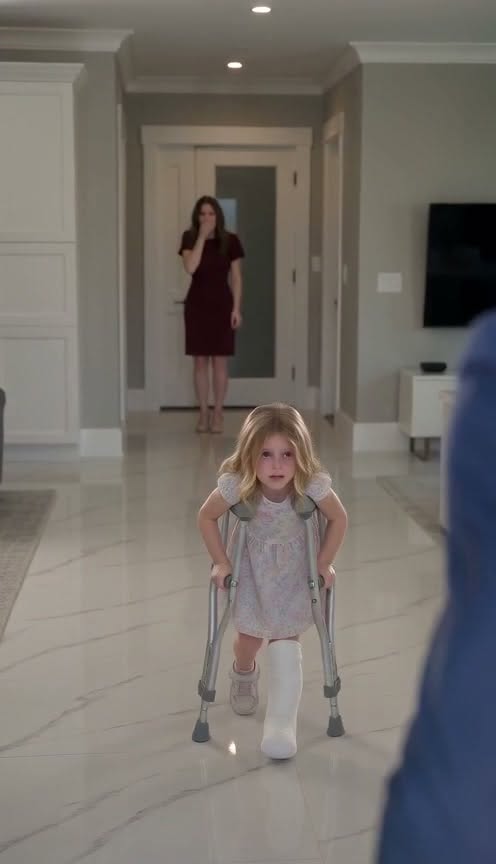
I came home in a navy suit I had not earned the right to feel proud of.
That is the first true sentence I can offer you. Not the door. Not the marble. Not the crutches clicking toward me like a clock that had learned my name. The suit. I had worn it through a meeting that ended with a handshake and a sentence about Q3, and I had kept it on in the car because taking it off in a parking garage felt like admitting the day had already won. The white shirt was open at the throat. The duffel was in my right hand. My wedding ring kept catching the sun every time I shifted gears, a small regular flash that I mistook for proof that the life waiting inside the glass door was still the life I had left that morning.
My name is Daniel Cole. I am thirty-eight. Emily is thirty-six. We live in a house that looks, from the patio, like a magazine learned how to breathe: white marble, grey walls, a long cream hallway that makes footsteps sound expensive, white double doors at the far end that we told the realtor we loved for the light. We told the realtor a lot of things. We told friends the house was “finally finished.” We told ourselves finished was the same as safe.
I need you to hear a correction before the rest of this becomes the story people prefer.
There were no children on that marble.
There were two porcelain dolls.
I am saying that again, slower, because the mind is a liar with good intentions. It sees a floral dress and a cast and a striped polo and it supplies pulse. It hears “Daddy” and it supplies a throat. I will not help it. Doll A is a girl-sized hyper-realistic porcelain figure with wavy blonde hair, painted tears, a pale floral dress, a white medical cast on the left leg, and silver crutches that click on stone. Doll B is a toddler-sized porcelain figure in a navy-and-white striped polo, posed as if it had been crying into a chest that was never supposed to be a chest. They are articulated. They are cold. They have weight that fools the biceps into tenderness. They are not alive.
And still I dropped the bag.
Still I went to my knees on my own floor as if the house had called a drill I had agreed to in a contract I don’t remember signing.
Emily was already in the hallway when I opened the glass door. Burgundy dress. Nude heels. One hand near her mouth the way people stand when a photograph is being taken of a disaster they caused. She did not come forward. She did not speak. The white double doors waited behind her like a second wife.
“Emily,” I said. “I’m here. What happened?”
The sentence left me before I had finished being a man returning from work. It came out of the part of marriage that keeps a first-aid kit in the kitchen and believes that arriving is the same as repairing.
Doll A was coming toward me on the crutches.
I want to describe that movement without giving it a soul, and I keep failing. Porcelain does not walk. Joints can be posed. A doll can be placed mid-stride by a person who wants a scene. That is the sane paragraph. The insane paragraph is this: the crutch tips ticked across the marble in a rhythm that matched my pulse, and the painted face lifted as I crossed the threshold, and for one stupid second I thought of every time I had said, casually, that the house felt too big for two people.
The duffel left my hand.
Thud.
The sound went down the hallway and came back thinner. Emily’s fingers pressed harder against her mouth. I knelt. I did not decide to kneel. My body performed an old instruction: when something small is crying in your house, you make yourself smaller than your pride.
I lifted Doll B.
The striped polo was cool. The painted mouth was open on a cry that had no breath behind it and still used up the air in the entry. I steadied Doll A’s crutch with my other hand because the cast made the whole figure look like a sentence that had been interrupted. No striking. No shaking. A pickup. The kind of pickup you do when you are trying to keep a display from hitting stone.
There was a dark-red mark near the bag.
I need that on the record with the same stubbornness I used the first time I wrote about this house. Spilled red wine. Not the other word. Fruit and tannin and the faint sweetness of a bottle opened when the afternoon was not supposed to need a bottle. No glass in sight. Just the stain, shaped like a small country on a map nobody wanted to study.
“I’ve got you,” I heard myself say. “I’ve got you.”
I said it to porcelain.
If you are still reading, you are already the kind of person who will either close this and call me unwell or keep going because you have also spoken kindly to an object when the room was wrong.
Close up, Doll A’s face was a craftsman’s argument about sorrow. Glossy tracks on painted cheeks. A mouth shaped around a confession. Beside it, Doll B’s eyelid was lowered as if sleep had arrived in the middle of panic and then thought better of leaving.
The house went quiet in the particular way expensive houses go quiet, which is not silence so much as insulation.
Then the girl-shaped doll did the thing I have not found a clean verb for.
It spoke.
I can give you the physics I preferred for the first hour: a speaker inside the torso, a recording, a cruel trick, Emily somewhere in the hallway with a phone and a timeline. I can give you the other physics, which has no dignity: the painted mouth moved the way paint should not move, and the voice that came out was small and careful and older than the face.
“I tried to keep him safe.”
I leaned in because that is what you do when a sentence arrives without a body you trust.
“Safe from what?”
The crutches made a tiny adjustment against my sleeve.
“Mommy said we had to stay quiet. She said not to tell you.”
I looked down the hallway.
Emily had not moved. The burgundy dress still made a dark column against the white doors. Her eyes were doing the work her mouth refused. I have loved that face across twelve years of rented apartments and a first mortgage and a kitchen remodel we argued about as if cabinets were theology. I have watched it sleep. I have watched it lie about being fine. I had not watched it look like a person standing in front of a verdict.
“Emily,” I said, and my voice had the duffel in it, the dropped weight, the suit, the whole performance of a husband who still thought names could reopen negotiations.
She did not answer.
The dolls were heavy in a way that was not only porcelain. Doll B’s head stayed against my chest. Doll A’s painted eyes found mine with an attention that made my skin try to leave.
I heard the next sentence leave me as if someone else had borrowed my throat.
“What’s behind that door?”
I did not point. I did not need to. In a house like ours there is always one door that is not really for light. We had called those white double doors a feature. We had photographed them for the listing we never posted because we were not selling, we were arriving. We had closed them when guests stayed too long in the hall. We had opened them when we wanted the place to look like a continuation instead of a decision.
Doll A’s face turned up.
“Daddy,” it said. “Please don’t leave us.”
I turned my head toward Emily.
That is the whole clip, if you are the kind of person who thinks a life can be timed. Entry. Dropped bag. Knees on marble. Two dolls. A stain of wine. A wife at a door. A question that made the hallway longer.
What a fifteen-second stranger would not know is how long we stayed inside that composition after the air ran out of new sounds.
I did not stand.
Standing would have required me to choose a direction: toward Emily, or toward the doors, or toward the glass behind me and the patio and the ordinary sun that still believed in weather. Kneeling kept me in the only honest posture I had left. A man in a navy suit on his own marble, holding décor as if décor could be orphaned.
Emily’s hand finally left her mouth.
“Daniel,” she said, and my name sounded washed.
“Open it.”
“I can’t.”
“That is not an answer that fits this floor.”
She laughed once, no humor, a dry click. “You think this floor is the problem.”
“I think I came home,” I said, “and the dolls were walking, and you were standing where a person stands when they have already chosen a side.”
“They weren’t walking when you left.”
“Don’t.”
“I’m telling you what I know.”
“Then tell me what I don’t.”
She looked at the crutches. She looked at the cast. She looked at Doll B’s striped polo the way you look at a photograph you regret framing.
“I told them to be quiet,” she said.
The sentence was small and it rearranged the kitchen in my head, the hallway, the marriage, the word them.
“Emily.”
“I know how it sounds.”
“It sounds like you spoke to objects as if they could report you.”
“They can,” she said.
I have been a reasonable man for a long time. Reasonable men ask for evidence. Reasonable men check for wires. Reasonable men walk to the doors and open them because a door is only a door until you let it become a religion.
I did not open them yet.
I asked the question underneath the question.
“Why is there a cast on that doll?”
Emily’s eyes shone in a way that was not quite crying. “Because I needed the house to remember she had been hurt.”
“She.”
“I heard myself say it too,” Emily whispered. “Do you think I like that?”
We bought the dolls after the winter we did not talk about correctly.
I will not dress that winter up for Facebook. There was a hospital that smelled like lemon and tape. There was a conversation with a doctor who used the word viable as if it were kindness. There was a drive home in which Emily held the passenger seatbelt with both hands like it might fly. There was a nursery we had already painted, and then unpainted, and then pretended was a guest room. People sent flowers that died on a schedule. People said you can try again as if trying were a sport.
The antique place was Emily’s idea. Rain on the windows. A man who called them display pieces and smiled when he said the tear on the smaller face was original. I should have walked out at original. Instead I watched Emily touch the lavender—no. That was another house. In this house it was a floral dress and a striped polo and a cast that was not on the doll when we paid.
The cast appeared later.
I need you to sit with that the way I have sat with it.
We brought them home and put them in a chair by the window because Emily said empty rooms invent footsteps. For a week they stayed where we placed them. Guests laughed the high laugh of people who do not want to be the first to say too real. I made a joke about insurance. Emily did not.
Then I started finding Doll A in different light.
Not moved across the house in a way I could blame on cleaning. Shifted. A crutch an inch farther from the wall. The painted face angled toward the white doors as if the doors had spoken first.
I told myself settling. I told myself marble reflections. I told myself grief makes interior designers of the living.
The afternoon I came home in the suit, I had texted Emily from the car: 10 minutes. She had liked the message. No words. A heart that looked, later, like a closed fist.
When I finally stood, my knees made a sound that embarrassed the hallway. I kept both dolls. I will not pretend that was strategy. It was superstition. If I put them down, I thought the floor might keep them.
“Walk with me,” I said.
Emily backed up until her shoulders found the white doors.
“If you open it,” she said, “you will not look at me the same.”
“I am already not looking at you the same.”
Her mouth trembled. “That’s fair.”
“What did you hide?”
She glanced at Doll A, then at me, then at the handle as if the handle had a mouth too.
“I hid the version of us that could not stand another empty room,” she said. “I hid a night I told the house to choose. I hid a bottle of wine I poured for a person who is not coming. I hid the fact that I asked the dolls to stay quiet because I heard them on the baby monitor we never threw away.”
The monitor.
I had put it in a box. I had labeled the box. I am the kind of man who labels boxes so that pain can be inventoried.
“You kept the monitor on,” I said.
“I turned it on last Tuesday because the guest room made a sound like breathing. There was no one in the guest room. Then there was a click. Then there was a voice that used your name the way a child uses a name when it wants the dark to have rules.”
“A recording.”
“Play it back, then,” she said, and her voice broke on then. “I tried. The file is empty. The light was green. I sat on the floor and listened to nothing after hearing everything.”
I reached for the handle.
The metal was colder than the rest of the house. Behind me, Doll B made a small posed hitch against my shirt. In my peripheral vision, Doll A’s painted head turned a degree toward the seam of the doors. I told myself articulation. I told myself my own arms. I told myself the sentence that has kept men like me employed: there is an explanation, and it will be humiliating, and humiliation is cheaper than wonder.
I opened the door.
Not both panels at first. One. A slice.
The room beyond was the room we called an office when guests asked and a spare when we were being braver. Curtains drawn in the middle of the day. A chair on its side. The smell of wine again, brighter, as if the bottle had been opened more recently than the stain by the duffel. On the floor, near the chair, a second silver chain I did not recognize as ours.
No person.
No animal.
No camera I could see from the threshold.
Just a room that had been arranged by a panic with good taste.
Emily made a sound I have only heard from her once, in that hospital corridor, when a machine changed its mind about beeping.
“I didn’t leave the chair like that,” she said.
“I believe you,” I said, and hated how much of the marriage was inside those three words.
I stepped in.
The dolls came with me because I could not negotiate with my hands. Daylight from the hall cut a triangle across the office floor and laid itself over the chain the way light in this house seems to prefer jewelry. I thought of another hallway, another triangle, another chain that should have been in a box. Different year. Same grammar.
“Whose necklace?” I asked.
Emily shook her head. “It looks like my mother’s.”
“Your mother is in Phoenix.”
“I know where my mother is, Daniel.”
“Then why—”
“I don’t know.” She pressed her palms together. “I know I poured wine I did not drink. I know I told the dolls not to tell you. I know I said stay quiet the way you say it to a room when you cannot bear to be witnessed failing.”
Doll A’s crutch tapped the doorframe.
One tap.
I looked down. The girl-shaped figure’s painted mouth was closed now. The tear tracks still shone. The cast looked newly white in the sliver of hall light, ridiculous and specific, a medical story attached to an object that could not bruise.
“Why the cast,” I said again.
Emily swallowed. “Because Tuesday night I found her— it — on the stairs. I picked it up. I said you’re fine. I said porcelain doesn’t break that way. Then I saw the seam at the knee. A hairline. I wrapped it. I put the cast on because if I could see the hurt, I could stop imagining a different hurt. I could stop hearing a cry that belonged to a winter we already survived.”
“And the crutches?”
“Were in the garage from when I sprained my ankle. You remember. You made soup and were unbearable about ice.”
I remembered. I remembered soup. I did not remember granting the house permission to reuse our injuries as costume.
We stood in the office until the triangle of light moved. That is a longer time than a video. That is a marriage sitting down inside a minute and refusing to get up. I set the dolls in the toppled chair after I righted it, and immediately felt the mistake of putting them down. Emily kept her back to the curtains. I opened them. Ordinary backyard. Ordinary fence. A neighbor’s sprinkler ticking like a smaller, dumber crutch.
Nothing out there had opened our doors.
I called Emily’s sister because I needed a living voice that was not ours. She answered on the second ring and laughed when I said the dolls had had a day. I did not tell her about the monitor. I did not tell her about the chain. I told her we might bring the figures over. She said her basement was already a museum of bad decisions and one more shelf wouldn’t kill her.
We did not drive them over that night.
That is the part that makes me look at this caption and know I should delete it, and also the part that makes me keep typing.
We left them in the office with the door open, because closing it felt like agreeing to a second act. We ate standing up. We did not pour wine. Emily washed the glass that was not by the stain, which is a sentence I cannot make sensible. There was no glass by the entry stain. There was a glass in the sink with a ring of red in it that had not been there in the morning.
I asked if she had drunk it.
She said she must have.
Must have is a hallway.
In bed I stared at the ceiling and listened for the monitor we had buried in a labeled box. No green light. No click. Only the air system, which in a house like this is designed to sound like nothing.
Near three I woke because Emily was not in the bed.
I found her in the hallway in the burgundy dress she had not taken off, standing in the same mark on the marble, facing the white doors. The doors were closed again. I had left them open. I would testify to that in a room with a flag.
“Emily.”
She did not jump. That frightened me more than jumping would have.
“They want you to hear it from them,” she said.
“There is no them.”
She turned her head. In the night lighting her face looked like the first day we saw the house, when she said we could be happy in a place this clean.
“Then why,” she asked, “are you whispering?”
I looked past her.
The office door—the door I had left open—was shut.
From underneath it came a sound so small I could have blamed the pipes if I had not already used the pipes too many times.
A crutch tip.
Then another.
Then a voice through wood, careful, the same careful I had heard on my knees in a navy suit with a duffel behind me and wine on the floor like a signature.
“Daddy. Please don’t leave us.”
I put my hand on the handle and felt the cold travel up my arm as if the house had a circulation of its own.
Emily’s fingers found my sleeve.
“If you go in,” she said, “do not ask them what I did. Ask them what I was afraid you would do if you knew the room was still empty.”
I could have been a better man in that sentence. I could have said I would never have left. I could have said empty rooms are allowed. I could have said we would sell the house and the dolls and the monitor and the whole architecture of almost.
Instead I opened the door.
The chair was on its side again.
Doll B was on the floor beside the wine, striped polo, painted cry, posed as if it had been set down mid-sob by someone who understood framing.
Doll A stood on the crutches in the triangle of hall light that should not have existed with the curtains closed. The cast was white. The floral dress was neat. The painted face was turned toward me with an attention that made my name feel borrowed.
On the desk—the desk that had been clear—sat the baby monitor, green light on, labeled box somewhere behind us in a past that had believed in labels.
No file.
No speaker I could see that would explain a voice coming from porcelain.
Only the two figures, and the chain, and my wife behind me in a dress the color of wine, and the long cream hallway waiting to carry whatever I decided to become.
I did not pick them up at first.
I did what I had done at the glass door when I still thought arriving was enough.
I said I was here.
I said what happened.
The girl-shaped doll’s painted mouth opened.
“Mommy said we had to stay quiet,” it said. “She said not to tell you.”
Emily made a broken sound.
I looked at my wife, and I looked at the dolls, and I looked at the closed curtains that hid an ordinary yard, and I understood the sentence this house had been practicing since winter:
some rooms stay empty on purpose,
and some rooms refuse,
and if you put a face on the refusal,
it will learn your name,
and it will wait for the door,
and it will ask you, in the smallest voice a man in a suit cannot bear,
not to leave.
I am writing this in the kitchen with daylight on the marble and the glass door locked from the inside, which is a joke the house allows me. The duffel is still by the entry. I have not gone to work. Emily is asleep in the guest room we keep calling a guest room. The white doors are closed. I have not opened them since the green light.
If you have a monitor in a box, I am not telling you to throw it away. I am telling you to notice whether it turns itself on.
If you have objects in your house that look too much like listeners, notice whether they stay where you put them.
If your partner ever stands at a door with a hand over her mouth and does not come forward when you say her name, do not start with blame. Start with the floor. Start with the stain. Ask whether it is wine.
It was wine.
I keep saying that.
I keep needing it to be wine.
Because if the red on the marble is only wine, then I am a husband who came home and knelt for porcelain and heard a sentence grief invented.
And if it is only wine,
then I can still walk down that hallway tomorrow,
open the glass door the other way,
and leave.
Doll A is at the end of the hall again.
I did not carry it there.
The crutches make no sound until I look,
and then they click once,
politely,
like a guest who knows I heard the first time.
Emily’s voice comes from the guest room, half-asleep, raw.
“Daniel? Don’t leave us.”
I cannot tell which doorway the sentence used.
I am standing up now.
I am still in the shirt I wore to a meeting about a future that did not include any of this.
I am going to the hall.
I am going to stop one step short of the cast, and the painted tears, and the striped polo, and the white doors that look, in this light, like teeth.
I am going to ask the house, as quietly as a man can ask a place that has already learned his name,
what it thinks I am the father of.