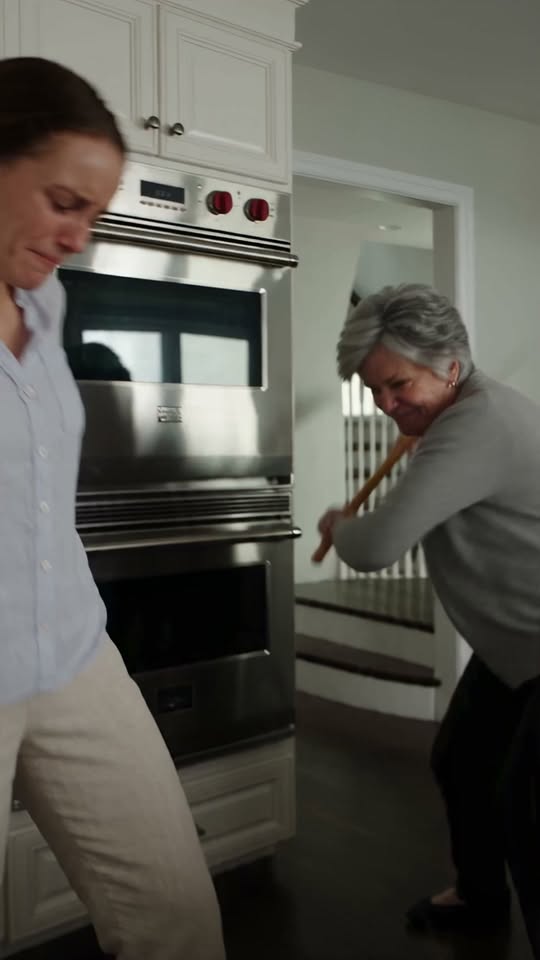
My name is Dr. Amara Cole. I’m 36 years old. I’m a clinical psychologist, which is funny because I spend my whole day helping other people name what is happening to them, and for three years I couldn’t name what was happening to me in my own kitchen.
I have warm deep-brown skin, shoulder-length black curls I finally learned how to love after years of straightening, and that afternoon I was wearing my favorite deep-teal blouse and cream wide-leg pants and my small gold earrings. My wedding ring. I was standing in our kitchen – the same bright modern white kitchen we’ve had since David and I bought this house. Double ovens with those red knobs, white cabinets, dark hardwood floor I always keep clean because I have a 10-year-old.
My daughter is Mila. She is 10. Biracial, medium-brown skin, hazel eyes that change color in the sun, thick dark curls I tie with a blue ribbon. She is the reason I stayed quiet for so long.
My husband is David Cole. 39. White, tall, broad-shouldered, short dark brown hair with stubble because he never remembers to shave on Saturdays, usually wearing a navy suit because he just came from the office. Good man. Loves his mother too much to see her clearly.
And his mother is Helen Cole. 63. White American, pale skin, sharp blue-gray eyes, perfect silver-blonde bob that never moves. Ivory cardigan, navy pants, pearl earrings. Wealthy. Socially influential. The kind of woman who chairs charity boards and knows the headmaster at Mila’s school on a first-name basis.
Everyone in our town loves Helen. That’s what makes this so hard to talk about.
That afternoon, Helen came over unannounced. She does that. She has a key. She says, “It’s my son’s house, I should be able to check on my granddaughter.”
Mila was upstairs doing homework. I was making tea in the kitchen.
Helen walked in, looked at my teal blouse and said, “Amara, dear, that color is… bold on you. Are you sure you want to wear that to the school fundraiser? People might get the wrong idea.”
That’s how she talks. Not loud. Not cruel in a way you can point to. Just small, precise cuts.
I said, “It’s my favorite blouse, Helen.”
She said, “Of course it is.”
Then she saw the broom. The yellow broom leaning against the pantry. Ethan, our neighbor’s kid, had left it there after helping David in the garage. It wasn’t even ours.
She picked it up.
Not to sweep. She held it like someone holds something when they want to make a point. She raised it. Not high enough to hit anyone. Just high enough to make me step back. A sharp, theatrical lift into the air. An implied swing.
I have worked with trauma patients for twelve years. I know what an implied threat does to the nervous system. Your body doesn’t wait to see if contact happens. It reacts to the intention.
I flinched. I am a 36-year-old Black woman with a doctorate, and I flinched in my own kitchen from a broom.
My daughter’s voice from the stairs was small. “Mom?”
I didn’t want Mila to see that. I immediately tried to make myself smaller. I crouched a little, not because I was hurt – there was no contact, no blood, no injury – but because when you have been made to feel like an intruder in your own home for years, your body starts to apologize before your mouth does.
Helen then reached toward my shoulder. Her hand coming at me, not to hit, but to grab, to pull me up, to correct my posture, to say “stand up straight, you’re embarrassing yourself.”
I blocked her. With my forearm. One movement. Open, clear, defensive. I didn’t push her. I didn’t grab her. I put my forearm up and said, “Don’t touch me.”
That was the first boundary I had ever set with her out loud.
The broom dropped. THUD. It hit the hardwood floor and just lay there, bright yellow and ridiculous.
And then Helen, in one motion that I have replayed in my mind a thousand times, sat back. Hard onto the floor. Bumped into one of our padded kitchen chairs on her way down. BANG! The chair slid across the floor.
She didn’t fall because I pushed her. I was two feet away, my forearm still up. She sat because when you have spent your whole life controlling the narrative, you know that the person on the floor is always the victim.
If you had walked in at that second, this is what you would have seen: a Black woman standing over a White older woman on the floor, a broom between them, a chair knocked over.
You would have made an assumption. Most people do.
That’s exactly when David walked in from the hallway, still in his navy suit, holding his phone.
He saw me, standing, breathing hard, in my teal blouse.
He saw his mother, 63 years old, silver-blonde bob, on the floor in her ivory cardigan.
He saw the yellow broom far away on the floor.
He saw the chair.
He said, “Mom?”
Helen’s voice instantly changed. Her sharp blue eyes filled with tears. “David, I just came to see Mila. I don’t know why Amara is so angry. I was just trying to help.”
I said, very quietly, because I was so tired, “David, she came at me with that broom.”
It sounds absurd. Who gets threatened with a broom? But it was never about the broom. It was about three years of, “Amara, are you sure you know how to handle Mila’s hair?” and “David, don’t you think Mila would be better off in a different school, one that understands children like her?” and “Amara, you people are always so sensitive.”
David gently held his mother’s wrist. Not squeezing. Not hurting. Just one controlled hold to keep her from reaching for me again, to create distance. He has never been a violent man. He is the most diplomatic man I know.
He was trying to keep peace the way he always does. One hand on his mother, one eye on his wife.
And then Mila’s voice came from the stairs. My 10-year-old, holding her tablet. The tablet we gave her for school.
“Mom, stop. I recorded everything.”
She wasn’t supposed to be there. She was supposed to be upstairs. But she had heard her grandmother’s voice and came to the top of the staircase. And she pressed record.
She held up the tablet. On it, clear as day, was our white kitchen. Helen raising the broom – that sharp implied swing. My shocked face. The SWOOSH sound it made in the air, but no contact. Me blocking with my forearm. The THUD of the broom dropping on its own. Helen stepping back on her own and sitting down, bumping the chair – BANG.
No hitting. No blood. No injury. But the truth was there.
David watched it. He watched it twice. The kitchen was so quiet I could hear the clock over the ovens.
He let go of his mother’s wrist.
He looked at me. Really looked at me. In my deep-teal blouse and cream pants that I had chosen because I felt confident that morning.
He said, “Amara, are you okay?”
No one had ever asked me that in that kitchen before.
I nodded. I couldn’t speak.
He turned to his mother, still sitting on the floor in her navy pants.
He said, “Mom, how long have you been doing this?”
Helen stood up. She brushed off her ivory cardigan. She looked at me, not with apology, but with calculation.
She said, “David, you’re going to believe a child and your… wife over your own mother?”
David said, “My wife’s name is Dr. Amara Cole. And my daughter’s name is Mila. And yes. I believe them. Because for the first time, I can see it.”
He picked up the yellow broom. He put it back in the pantry, far away. He closed the pantry door.
Helen left. She didn’t slam the door. She never slams doors. She closes them softly, so she can later tell her friends that she was the dignified one who left quietly while we were hysterical.
After she left, Mila came down the stairs and hugged my waist. She is getting so tall. She said, “Mommy, Grandma is mean to you. Why?”
How do you explain to a 10-year-old biracial girl that sometimes people love their granddaughter but have never truly accepted her mother? How do you explain that sometimes the broom is never about sweeping?
I told her the truth I tell my patients: “Grandma loves your dad in a way that makes it hard for her to make space for anyone else. That’s her work to do, not yours. Your job is to be 10.”
That night, David found more on the tablet. After we thought Mila had stopped recording, the audio kept going for 30 more seconds. Helen was in the driveway on the phone with someone – probably the admissions director at Mila’s private school, the prestigious academy with the blue-and-gold banners where Mila just won an academic award.
We could hear her voice, clear: “Take her name off the list. That scholarship should go to a family who really belongs there.”
Mila’s name. Off the scholarship list. The list she earned because she got the highest math score in her grade.
Mila heard it. She looked at me with those hazel eyes and said, “Grandma tried to take my award?”
That was the moment David finally understood. It was never about a broom. It was never about a blouse. It was about who gets to belong.
My name is Dr. Amara Cole. I am 36 years old. I have warm deep-brown skin and shoulder-length black curls and a daughter who is braver than I was at 10.
I have spent three years crouching in my own kitchen. Yesterday, I blocked. I created distance. And my daughter recorded everything.
If you have ever been the Amara in a white kitchen with red knobs on the ovens, if you have ever had a Helen who raises things that never quite hit you but always make you flinch, you are not sensitive. You are not imagining it. And you are not alone.
The broom is back in the pantry. The kitchen is still white. But for the first time, it feels like it belongs to me and Mila, too.
Tomorrow Part 2: What David did after he heard Helen say “Take her name off the list.” He called the school. And what the headmaster told him made him pack an overnight bag for his mother and tell her she is not welcome back until she goes to family therapy with us. All three of us. And me.
If this hit home for you, share it. Not for me. For the next Amara who thinks she has to stay quiet to keep the peace. The peace was never peaceful if you were the only one holding your breath.
#MyStory #MixedFamily #MotherInLaw #Boundaries #BiracialMotherhood #Healing #YouBelong #FamilyDrama