I am Dr. Amara Cole, aged thirty-six. As a professional therapist, my daily work involves guiding individuals through the process of labeling their internal struggles; ironically, I spent three years unable to identify the turmoil occurring right inside my home.
My complexion is a rich cocoa, and my dark hair falls in curls past my shoulders, which I finally cherish after years of chemical straightening. During that particular afternoon, I donned my preferred teal top, pale wide-legged trousers, and small gold studs, along with my wedding band. Our kitchen remained the pristine, modern space David and I purchased together years ago, featuring ovens with distinct crimson dials, light-colored cabinetry, and dark wooden floors that I maintain meticulously for my ten-year-old child.
Mila is my daughter. She is ten years old, biracial, with medium-toned skin and hazel eyes that shift hues under sunlight. I fasten her thick, dark tresses with a navy ribbon. She is the primary reason I maintained my silence for such an extended duration.
My spouse is named David Cole, thirty-nine. He is a tall, white man with broad shoulders and dark, short hair, often sporting stubble on weekends. He typically wears a navy professional suit upon returning from his job. He is a good man, though he loves his mother too deeply to perceive her true character.
Helen Cole is his mother, sixty-three. A white American woman, she possesses fair skin, piercing blue-gray eyes, and a flawless silver-blonde haircut that remains perfectly in place. She wears ivory sweaters and navy slacks, accented by pearl jewelry. She is wealthy and socially prominent, managing charitable organizations and maintaining close ties with the administrators at Mila’s school.
Everyone in our community adores Helen, which is why discussing this situation is so incredibly difficult.
That afternoon, Helen arrived without warning. She possesses a spare key and habitually visits, claiming it is her son’s residence and that she is entitled to check on her grandchild.
Mila was occupied with schoolwork upstairs while I prepared tea.
Upon entering, Helen scrutinized my teal shirt and remarked, Amara, dear, that hue is quite intense for you. Are you certain that is appropriate for the school event? People might draw incorrect conclusions.
That is her typical manner of speaking. She is never loud or overtly aggressive, yet she delivers small, precise verbal attacks.
I replied, It is my favorite top, Helen.
She responded, Of course it is.
Then, her gaze landed on the yellow cleaning tool leaning against the pantry door. A neighbor’s child, Ethan, had left it behind after assisting David in the garage; it did not even belong to us.
She grabbed it.
She did not intend to clean. She gripped it like someone holding a weapon to emphasize a point. She hoisted it upward—not high enough to strike, but just enough to force my retreat. It was a sharp, dramatic motion, a simulated blow.
Having treated trauma victims for over a decade, I recognize how a perceived threat impacts the nervous system. Your biology does not wait for physical impact; it responds to the implied danger.
I recoiled. Despite being a thirty-six-year-old Black woman with a doctoral degree, I flinched in my own home because of a broom.
Mila’s voice drifted down from the stairs, sounding small. Mom?
I wanted to shield Mila from this scene, so I instinctively tried to shrink. I hunched over slightly—not because I had been struck, as there was no contact or injury—but because years of being treated like a guest in your own home cause your body to offer apologies before you even speak.
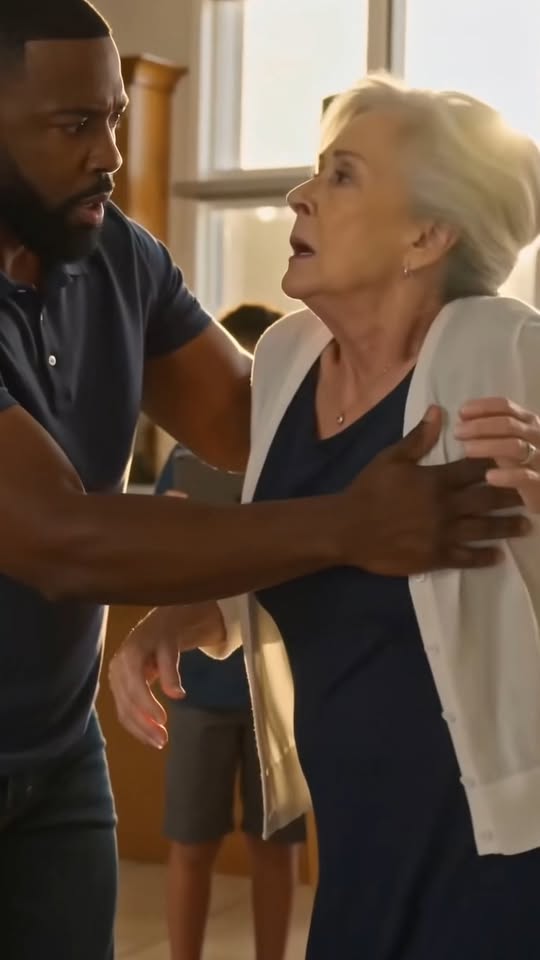
Helen then reached for my shoulder. Her hand moved toward me, not to hit, but to seize and pull me upright, as if to correct my posture and demand I stop embarrassing myself.
I blocked her with my forearm in a single, fluid, defensive gesture. I did not push or grab her; I simply raised my arm and stated, Do not touch me.
It was the first time I had ever established such a boundary with her verbally.
The broom fell with a loud thud onto the hardwood, lying there in its ridiculous, bright yellow state.
Then, in a movement I have replayed mentally countless times, Helen sat down forcefully, colliding with a kitchen chair that slid across the floor with a bang.
I had not pushed her; I was standing two feet away with my arm still raised. She sat because those who control the narrative know that the person on the floor appears to be the victim.
Had you walked in at that moment, you would have seen a Black woman standing over an older white woman, with a broom and an overturned chair between them. You would have made assumptions, as most people do.
At that exact moment, David entered from the hallway, checking his phone in his navy suit.
He observed me standing there, breathless in my teal blouse.
He saw his mother, sixty-three, on the floor in her ivory cardigan.
He saw the yellow broom lying far away.
He saw the displaced chair.
He asked, Mom?
Helen’s tone shifted immediately, her blue eyes brimming with tears. David, I only came to visit Mila. I do not understand why Amara is so hostile. I was merely trying to be helpful.
I spoke quietly, feeling utterly exhausted. David, she threatened me with that broom.
It sounds absurd—who faces threats from a broom? Yet, it was never about the tool. It was about three years of comments like, Amara, are you sure you can manage Mila’s hair? and David, wouldn’t Mila thrive in a different school, one that understands her better? and Amara, your people are always so sensitive.
David gently held his mother’s wrist. He was not hurting her; he simply applied a controlled grip to prevent further reaching and to create space. He is not a violent man; he is the most diplomatic person I know.
He sought peace, as he always does, with one hand on his mother and his attention on me.
Then, Mila’s voice came from the stairs. My ten-year-old stood there holding the tablet we gave her for school.
Mom, stop. I recorded everything.
She was meant to be upstairs, but she had heard her grandmother and started recording from the top of the landing.
She raised the tablet. It displayed our white kitchen clearly: Helen lifting the broom, the sharp, implied swing, my startled expression, the whoosh of air, my defensive block, the broom dropping, and Helen choosing to sit down and hit the chair.
There was no violence, no blood, and no injury, but the truth was captured.
David watched the recording twice. The silence in the kitchen was so profound I could hear the clock ticking.
He released his mother’s wrist and looked at me—truly looked at me—in the outfit I had chosen because I felt confident that morning.
He asked, Amara, are you okay?
No one had ever inquired about my well-being in that kitchen before.
I nodded, unable to speak.
He turned to his mother, who remained on the floor in her navy trousers.
He asked, Mom, how long has this been going on?
Helen stood up, brushed off her sweater, and looked at me with calculation rather than remorse.
She said, David, are you going to trust a child and your… wife over your own mother?
David replied, My wife’s name is Dr. Amara Cole. My daughter’s name is Mila. And yes, I believe them. For the first time, I can see the truth.
He retrieved the yellow broom, placed it deep inside the pantry, and shut the door.
Helen departed. She did not slam the door—she never does. She closes them gently so she can later claim she was the dignified party while we were being hysterical.
After she left, Mila descended the stairs and embraced my waist. She is growing so fast. She asked, Mommy, why is Grandma mean to you?
How do you explain to a ten-year-old biracial girl that someone can love her but never fully accept her mother? How do you explain that a broom is rarely just for sweeping?
I shared the truth I tell my patients: Grandma loves your father in a way that prevents her from making room for anyone else. That is her burden, not yours. Your job is simply to be ten.
That evening, David discovered more on the tablet. The audio continued for thirty seconds after we thought Mila stopped recording. Helen was in the driveway, speaking to someone—likely the admissions director of Mila’s prestigious private academy.
We heard her voice clearly: Remove her name from the list. That scholarship should be given to a family that truly belongs there.
Mila’s name. Off the scholarship list. The list she earned through her academic excellence in mathematics.
Mila heard it. She looked at me with those hazel eyes and asked, Grandma tried to take my award?
That was the moment David finally realized. It was never about a broom or a blouse; it was about who is permitted to belong.
I am Dr. Amara Cole, thirty-six years old. I have deep-brown skin, shoulder-length curls, and a daughter who possesses more courage than I did at her age.
I spent three years cowering in my own home. Yesterday, I set a boundary. I created distance. And my daughter captured it all.
If you have ever been the Amara in a white kitchen, if you have ever faced a Helen who raises objects that never strike but always make you flinch, know that you are not being overly sensitive. You are not imagining it, and you are not alone.
The broom is tucked away. The kitchen remains white. But for the first time, it finally feels like it belongs to me and Mila.
Tomorrow in Part 2: What David did after hearing Helen demand that Mila be removed from the list. He contacted the school, and the headmaster’s response prompted him to pack an overnight bag for his mother, informing her she is not welcome until she joins us for family therapy. All of us. Including me.
If this resonates with you, share it. Not for my sake, but for the next Amara who believes she must remain silent to maintain peace. Peace is not truly peaceful if you are the only one struggling to breathe.