
Gideon caught it before it hit the floor.
“He thought you were dangerous to him,” Gideon continued. “Maybe you knew something without realizing it.”
“I knew nothing.”
“Then perhaps you saw something.”
Lydia shook her head.
“I worked. I slept. I worked again.”
Gideon studied her.
“Think.”
She did.
Against her will.
Long nights in the factory.
Briggs whispering with men near the loading entrance.
Ledger books carried downstairs.
Crates arriving after midnight.
The women were told they contained dyes.
Then Lydia remembered one night.
Three months earlier.
She had been asked to correct a production ledger.
A freight invoice had been accidentally tucked inside.
Twenty-six crates of machinery parts.
But the factory had received only six.
She had assumed it was clerical error.
She looked at Gideon.
“The shipments.”
His gaze sharpened.
“What shipments?”
“Briggs was falsifying freight records.”
Gideon slowly stood.
“What did you see?”
“Numbers. Crates. Different destination codes.”
“Do you remember them?”
“I remember numbers.”
Lydia had always remembered numbers.
It was why she had balanced production books faster than men paid twice her wages.
She closed her eyes.
“Philadelphia to Pittsburgh. Pittsburgh to Omaha. Omaha…”
She opened them.
“To Boise.”
Gideon’s face changed.
Not fear.
Recognition.
He went immediately to a rough map nailed above the table.
“Say them again.”
She did.
Gideon traced the routes.
Then his finger stopped.
Black Elk Pass.
Their mountain.
Lydia’s heart began pounding.
“Gideon?”
He looked at her.
“Briggs didn’t send you away from his operation.”
The words struck like ice water.
“He sent you directly into the middle of it.”
Part 4 — SOMEONE WAS ALREADY OUTSIDE THE CABIN
Gideon blew out the lamp.
Lydia barely had time to gasp before darkness swallowed the cabin.
“Don’t move,” he whispered.
She heard him cross the floor.
Then the soft metallic sound of a rifle being lifted from its hooks.
“What is it?”
“Horse.”
Lydia listened.
At first there was only wind.
Then—
A dull sound.
Muffled beneath the storm.
Hooves.
One horse.
Maybe two.
Gideon moved beside the window without standing directly in front of it.
“No one travels Black Elk Pass in this weather.”
Lydia clutched the robe tighter.
“Could someone be lost?”
“People who are lost call out.”
The horse stopped.
A moment later, someone knocked.
Three slow knocks.
Gideon did not answer.
Another knock.
Then a man’s voice came through the door.
“Rourke?”
Lydia’s blood froze.
She knew the voice.
Not Briggs.
Edmund Crowley.
The marriage agent.
“Gideon,” she breathed.
His hand lifted for silence.
Crowley knocked again.
“Rourke, open the door before I freeze to death.”
Gideon finally spoke.
“State your business.”
Crowley laughed.
“Business? I delivered you a wife.”
“Without my permission.”
Silence outside.
Then Crowley said, “Ah.”
Another voice came from farther away.
Lydia couldn’t identify it.
Gideon leaned toward her.
“Cellar hatch. Behind the stove.”
“I’m not hiding.”
“You are if bullets start coming through the walls.”
“I can shoot.”
His eyes flicked toward her.
“You can?”
“No.”
Despite everything, Gideon almost smiled.
“Then cellar.”
She glared at him.
Then crawled toward the hatch.
Before descending, she caught his sleeve.
“Don’t die.”
Gideon looked down at her hand.
A strange tenderness crossed his battered face.
“I’ll make an effort.”
Lydia disappeared below.
From the darkness beneath the floorboards she heard Gideon slide the bolt open.
Cold wind rushed into the cabin.
Crowley’s voice became clearer.
“Ugly night.”
“Ugly company.”
“You always were charming.”
“What do you want?”
“To collect something.”
Lydia stopped breathing.
Crowley continued.
“The girl.”
Silence.
“She’s my wife.”
“On paper.”
“Good enough.”
Crowley sighed.
“Gideon, don’t make this difficult.”
A second man spoke.
“You heard him, Rourke.”
Lydia recognized that voice.
Not from the factory.
From the railway station.
The conductor who had handled her trunk.
They had been watching her from the beginning.
Crowley spoke again.
“Miss Fenwick accidentally carried information that belongs to my employer.”
Gideon said, “What information?”
“Where is she?”
“I asked you a question.”
There was a pause.
Then Crowley said, “Ledgers.”
Lydia frowned.
She had carried no ledgers.
Then she remembered.
Her sewing case.
Before leaving Philadelphia, one factory girl named Mara had pushed a bundle of fabric scraps into Lydia’s trunk.
“Something to remember us by,” Mara had said.
Lydia had barely looked at them.
Suddenly her heart slammed.
The trunk.
It still stood beside Gideon’s workbench.
Above her.
Crowley’s boots entered the cabin.
“One last chance,” he said.
Gideon replied quietly.
“No.”
The gunshot was deafening.
Lydia screamed.
Something heavy crashed against the floor.
She shoved open the cellar hatch.
“Gideon!”
He was still standing.
Crowley was not.
The marriage agent lay against the wall, clutching his shoulder.
His pistol was on the floor.
Gideon’s rifle remained trained on the second man outside.
“Get inside.”
The man ran.
Gideon fired once through the doorway.
A horse screamed.
Then hoofbeats vanished into the storm.
Crowley groaned.
“You fool.”
Gideon kicked his pistol away.
“Lydia, rope.”
She scrambled toward the shelf.
Together they bound Crowley’s wrists.
His face had gone gray.
Lydia stared at him.
“You lied to me.”
Crowley laughed weakly.
“My dear, I made you an excellent match.”
“You delivered me like cargo.”
His eyes changed.
Cold.
“Everyone is cargo to someone.”
Gideon’s expression became murderous.
Lydia touched his arm.
“Don’t.”
He looked at her.
Not because she feared for Crowley.
Because she feared what killing him would do to Gideon.
He understood.
His fists loosened.
Lydia hurried toward her trunk and threw it open.
Beneath her dresses lay the bundle Mara had given her.
She cut the stitching.
Inside was a narrow ledger.
And a note.
Lydia unfolded it.
Her eyes filled with tears.
Lydia—if something happens to me, these pages prove Briggs is moving stolen payroll gold under false freight numbers. You remember numbers better than anyone. I knew you were the only one who could understand them. Forgive me. —Mara
Lydia whispered, “Oh God.”
Crowley began laughing.
“That stupid girl.”
Lydia turned slowly.
“What happened to Mara?”
Crowley smiled.
Gideon stepped between them.
“What happened to her?”
Crowley leaned his head against the wall.
“Ask Briggs.”
Outside, a horse whinnied.
One that had not fled.
Gideon looked toward the door.
Then Lydia heard another sound.
Sleigh bells.
Many of them.
Coming up the mountain.
Crowley’s smile widened.
“You should have handed her over.”
Part 5 — THE MAN LYDIA FLED HAD COME TO CLAIM HER
They came out of the storm carrying lanterns.
Five men.
Then six.
Then Lydia saw the seventh.
Alton Briggs dismounted from a black horse wearing a fur-lined coat far too elegant for the mountains.
Snow settled on his shoulders.
He looked exactly as he had in Philadelphia.
Smooth hair.
Neat gloves.
Perfect manners.
The face of a man who believed the world existed for him to arrange.
“Lydia,” he called.
She stood inside the cabin with Gideon’s spare revolver trembling in her hands.
Briggs smiled when he saw her through the open doorway.
“There you are.”
Her skin crawled.
Gideon stepped onto the porch.
His rifle hung loosely at his side.
“Arthur Bell.”
For the first time, Briggs’ smile vanished.
“So,” he said. “The mountain brute remembers me.”
“I remember everything.”
Briggs looked toward Lydia.
“Has he told you about Eleanor?”
“Yes.”
“How touching.”
Gideon’s hand tightened around the rifle.
Briggs laughed.
“She was foolish.”
The temperature seemed to drop.
Lydia watched Gideon carefully.
This was the moment he had spent fourteen years imagining.
She could see it.
The desire to pull the trigger.
To finish the story with one movement of his finger.
But Gideon did not raise the rifle.
Briggs looked almost disappointed.
“You’ve softened.”
“No.”
Gideon’s voice was low.
“I just learned revenge and justice aren’t always the same thing.”
Lydia stared at him.
Briggs shrugged.
“Then justice can freeze with the rest of you.”
He gestured toward the cabin.
“I want the ledger.”
Lydia stepped onto the porch.
Gideon glanced back sharply.
“Inside.”
“No.”
Briggs smiled.
“There’s the stubborn little seamstress.”
Lydia held up the ledger.
“You mean this?”
Every man outside shifted.
Briggs’ eyes sharpened.
“Give it to me.”
“Why?”
“You have no idea what it means.”
“I know exactly what it means.”
Lydia opened the ledger.
“You moved stolen payroll gold through textile shipments. Philadelphia to Pittsburgh. Pittsburgh to Omaha. Omaha to Boise.”
Briggs’ face became still.
She continued.
“You changed quantities by multiples of twelve. That was your code.”
Gideon looked at her, impressed despite the danger.
Lydia turned pages.
“Shipment 416 wasn’t machinery. It was gold.”
One of Briggs’ men glanced toward him.
Briggs noticed.
“Quiet.”
Lydia smiled faintly.
“There’s more.”
Briggs’ expression darkened.
“Lydia.”
“You’ve been cheating them too.”
That got the men’s attention.
She read aloud.
“Payments owed to Samuel Creed, Jonas Pike, Tomas Vale…”
Three men shifted.
“…and Walter Hobb.”
The largest man in Briggs’ group frowned.
“That’s me.”
Briggs snapped, “She’s lying.”
Lydia continued.
“Each man receives forty dollars per shipment. Your private column records twenty.”
Hobb turned toward Briggs.
“You said expenses took half.”
“They did.”
“No,” Lydia said. “They didn’t.”
Chaos broke instantly.
Two men started shouting.
Briggs reached for his revolver.
Gideon raised his rifle.
A shot cracked.
Lydia flinched.
But Briggs had fired into the air.
“Enough!”
His men fell silent.
Briggs’ face was no longer pleasant.
The mask had finally slipped.
“You think numbers make you powerful?”
He looked at Lydia.
“You were nothing in Philadelphia. You are nothing here.”
Lydia’s hands stopped shaking.
Perhaps because she suddenly understood something.
Briggs needed people frightened.
Without fear, he had very little left.
“You chased me across two thousand miles,” she said. “That doesn’t sound like nothing.”
One of the men laughed before quickly stopping.
Briggs’ face twisted.
“Take her.”
Nobody moved.
“I said take her!”
Hobb spat into the snow.
“You owe me eighty dollars.”
Another man said, “Hundred and twenty for me.”
Gideon almost smiled.
Briggs pulled his gun.
This time he aimed directly at Lydia.
Gideon stepped in front of her.
Briggs fired.
Gideon jerked backward.
Lydia screamed.
He fell against the porch railing.
Something inside her broke open.
Not fear.
Rage.
Lydia raised the revolver.
Briggs laughed.
“You won’t shoot.”
She pulled the trigger.
The bullet struck his gun from his hand.
Briggs stared at her in disbelief.
Lydia stared too.
“I was aiming for your shoulder.”
From behind her, Gideon groaned.
“You’re a terrible shot.”
She almost sobbed from relief.
The bullet had grazed Gideon’s upper arm.
Before Briggs could move, his own men seized him.
Hobb twisted his arms behind his back.
Briggs screamed.
“You idiots! I can make you rich!”
“You already made yourself rich,” Hobb said.
Then came another sound.
Hooves.
Many horses.
Briggs’ face lit with hope.
But Gideon looked toward the mountain road and smiled.
Through the storm rode twelve mounted men.
At their head was the sheriff from Boise.
Gideon had sent a message days ago through a trapper who had passed the cabin.
He had known trouble was coming.
Lydia looked at him.
“You knew?”
“I suspected.”
“You might have told me.”
“I was considering it.”
She stared at him.
“Consider faster next time.”
Despite the blood on his sleeve, Gideon laughed.
Then Sheriff Ezra Cole stepped onto the porch.
He looked at Briggs.
“Arthur Bell?”
Briggs said nothing.
Cole smiled.
“You have been very difficult to find.”
Lydia finally exhaled.
She thought it was over.
She was wrong.
Because when the sheriff opened Mara’s ledger, one loose page slipped out and fell onto the floor.
Gideon picked it up.
He read three lines.
His face went white.
“What?” Lydia asked.
He handed her the page.
At the bottom was a list of names.
Edmund Crowley.
Arthur Bell.
And one more.
Gideon Rourke.
Part 6 — THE LEDGER SAID GIDEON WAS PART OF IT
Lydia read his name twice.
Then a third time.
The room filled with deputies, prisoners, melting snow, blood, and voices, but suddenly she could hear none of them.
Only Gideon.
His name.
Inside Briggs’ criminal ledger.
She looked up.
Gideon had gone completely still.
Briggs began laughing.
It was not a pleasant laugh.
“There,” he said. “Now she knows.”
Sheriff Cole turned toward Gideon.
“Explain.”
“I can’t.”
Lydia felt as though someone had removed the floor beneath her.
“What do you mean you can’t?”
“I’ve never seen that page.”
Briggs smiled from where Hobb held him.
“He lies well for such an ugly man.”
Gideon crossed the room so fast that two deputies blocked him.
Briggs laughed harder.
“Tell her, Rourke.”
“Tell me what?”
Briggs’ eyes fixed on Lydia.
“That this cabin was purchased with my money.”
Lydia turned.
Gideon said nothing.
“Is that true?”
His silence hurt more than an answer.
Finally:
“Yes.”
Lydia stepped back.
Gideon spoke quickly.
“But not the way he means.”
“Then what way?”
Gideon looked toward Sheriff Cole.
“Fourteen years ago, when Bell disappeared after Eleanor died, I found money hidden in the boardinghouse room he abandoned.”
“How much?”
“Three thousand dollars.”
Lydia’s lips parted.
A fortune.
“I should have turned it over,” Gideon said. “I didn’t.”
“Why?”
“Because I wanted to hunt him.”
He looked ashamed for the first time since Lydia had met him.
“I used part of it to buy land. Part to search for him. I told myself I’d repay every dollar if I found where it came from.”
Briggs grinned.
“But he never did.”
Gideon looked at Lydia.
“The cabin came from stolen money.”
Lydia sat down.
Sheriff Cole examined the ledger page.
“This notation beside Gideon’s name isn’t a payment entry.”
Briggs’ smile faded.
Cole continued.
“It says recover.”
Gideon looked up.
The sheriff turned the page toward them.
Rourke — recover Bell funds. Eliminate if necessary.
Lydia read it.
Then looked at Briggs.
“You weren’t paying Gideon.”
“No,” Sheriff Cole said. “Bell had marked him for death.”
Briggs said nothing.
Gideon slowly exhaled.
Lydia felt something close to anger.
She had spent weeks assuming Gideon concealed dangerous secrets.
He had.
But none were the secrets she imagined.
Still, one question remained.
“Why marry me?”
Gideon looked confused.
“I told you—I didn’t arrange it.”
“No. Why agree when I arrived?”
He stared at her.
Everyone else in the cabin suddenly became very interested in the floor.
Gideon cleared his throat.
“You looked hungry.”
Lydia blinked.
“That is your reason?”
“You were standing at the station with one trunk and thin gloves.”
“That is not a reason to marry someone.”
“I know.”
“Then?”
Gideon looked uncomfortable enough to face another armed gang.
Finally he said:
“I saw you look at me.”
Lydia waited.
“And?”
“You were frightened.”
“That convinced you?”
“No.”
His voice softened.
“You were frightened, and you stayed anyway.”
Lydia’s throat tightened.
Gideon continued.
“I thought any woman brave enough to cross half the country alone deserved at least one person who would not use her fear against her.”
No one spoke.
Even Briggs looked away.
Lydia swallowed hard.
“So you married me out of pity?”
Gideon’s brow furrowed.
“Hell no.”
A deputy coughed to hide a laugh.
Gideon looked directly at her.
“I married you because when Crowley asked whether you accepted me, you looked me straight in the eye before answering.”
“And?”
“I liked that.”
“That’s all?”
“No.”
He scratched his beard.
“You ate three biscuits in six minutes.”
Sheriff Cole laughed openly.
Lydia stared at Gideon.
Then, against all reason, she started laughing too.
The laughter came harder.
Weeks of fear.
The storm.
The gunfire.
Briggs.
The marriage.
Everything spilled out until she had tears running down her face.
Gideon watched her with cautious concern.
“You all right?”
“No.”
She wiped her eyes.
“But I think I might be.”
For one brief moment, Lydia believed perhaps the worst was finished.
Then a deputy opened the door.
“Sheriff?”
“What?”
“We’ve got a problem.”
Outside, the storm had intensified.
Snow had buried most of the road.
The deputy pointed toward the ridge.
“Slide took out the pass.”
Cole frowned.
“How bad?”
“Bad enough nobody’s riding down tonight.”
Then another deputy ran from the stable.
“Fire!”
Everyone turned.
A red glow was rising behind the trees.
Gideon’s barn.
Lydia looked toward Briggs.
His hands were still tied.
Crowley was unconscious.
Then she counted the prisoners.
One was missing.
The railway conductor.
And the fire was spreading toward the cabin.
Part 7 — THE MOUNTAIN BURNED WHILE THE STORM CLOSED IN
Wind turned sparks into weapons.
The barn roof caught first.
Then the woodshed.
Gideon ran into the snow without his coat.
“Water line!”
Men scattered.
Prisoners and deputies alike formed a bucket chain from the well.
Lydia wrapped a blanket around her shoulders and raced toward the cabin.
“Where are you going?” Gideon shouted.
“The papers!”
“Leave them!”
“They’re evidence!”
“Lydia!”
She was already inside.
Smoke pushed through the rafters.
The fire had reached the rear wall.
She grabbed Mara’s ledger, the railway invoices, Gideon’s papers, and shoved them into her trunk.
Then she heard a sound behind her.
Click.
A pistol hammer.
Lydia froze.
The railway conductor stood near the door.
Blood ran from his temple.
“You always were troublesome,” he said.
Lydia slowly turned.
“You work for Briggs.”
“I worked for whoever paid.”
He pointed the pistol at the trunk.
“Hand over the ledger.”
Lydia looked toward the window.
Outside, Gideon was twenty yards away.
Too far.
She lifted the ledger.
The conductor smiled.
“Good girl.”
Lydia threw it into the fireplace.
He screamed.
“No!”
He lunged toward the flames.
Lydia grabbed the iron kettle.
It was still half full.
She swung with both hands.
The kettle struck the side of his head with a deep clang.
He collapsed.
Lydia stared at him.
“I can’t shoot.”
She dropped the kettle.
“But I can manage cookware.”
The ledger had landed beside the fire rather than inside it.
She snatched it up.
Then the ceiling groaned.
“Lydia!”
Gideon appeared through the smoke.
He crossed the room in three strides and grabbed her.
The burning rafters collapsed behind them as they burst through the door.
They hit the snow together.
Gideon rolled over her, shielding her as sparks showered down.
For several seconds neither moved.
Then Lydia whispered, “I’m not hurting.”
Gideon looked down at her.
In the middle of a burning homestead and a mountain storm, he actually smiled.
“Good.”
The cabin could not be saved.
By dawn, only the stone chimney remained standing.
Lydia sat wrapped in buffalo robes inside the root cellar while deputies guarded Briggs and the others.
Gideon sat beside her.
His land was blackened.
His cabin was gone.
Most of his tools were gone.
Half the stored winter grain had burned.
Lydia studied his face.
“You spent fourteen years building this.”
“Yes.”
“And now?”
Gideon shrugged.
“Build again.”
She looked toward the smoking ruins.
“With what?”
“My hands.”
Lydia was quiet.
Then:
“And if I don’t want to stay?”
He turned toward her.
The question cost her more than she expected.
Gideon answered without hesitation.
“Then when the pass opens, I’ll take you wherever you want.”
“You’d let me leave?”
“You were never mine to keep.”
Lydia looked down at the silver ring on her finger.
All her life she had believed safety came from anticipating what men wanted.
Work harder.
Speak softer.
Avoid anger.
Never owe anyone too much.
Gideon had broken every rule she had learned.
He had given her food without asking payment.
Warmth without ownership.
Marriage without possession.
And when she said, “It hurts,” he had moved away.
That one act had frightened her because she had no language for it.
Now she did.
Respect.
Lydia looked at his burned home.
Then at the man beside her.
“I don’t want to go back to Philadelphia.”
“Good.”
“But I also don’t want to spend the next twenty years freezing in a root cellar.”
“Reasonable.”
“So we build better.”
Gideon stared at her.
“We?”
She nodded.
“We.”
Something changed in his face.
Slowly.
Carefully.
Hope.
He looked almost afraid of it.
Lydia touched his scarred cheek.
Gideon did not move.
He waited.
She leaned forward and kissed him.
It was brief.
Gentle.
Entirely her choice.
When she pulled back, Gideon looked stunned.
“You all right?” she asked.
“No.”
She smiled.
“But you might be?”
“Possibly.”
Outside, Sheriff Cole began shouting.
They climbed from the cellar.
A rider was coming over the eastern ridge.
Impossible.
The pass was blocked.
Yet the rider came through waist-deep snow, waving a telegram pouch over his head.
“Message for Sheriff Cole!”
Cole tore it open.
His eyes widened.
Then he looked at Lydia.
“Mrs. Rourke?”
“Yes?”
“You’re going to want to read this.”
She took the telegram.
And the first line made her knees weak.
MARA FENWICK ALIVE.
Lydia stared.
“No.”
Cole pointed.
“Keep reading.”
Mara was not Lydia’s sister.
Fenwick was simply a common surname.
But Mara had survived Briggs.
She had escaped Philadelphia after hiding the ledger in Lydia’s luggage.
She had gone directly to federal authorities.
And she had brought witnesses.
Federal marshals were already headed west.
Lydia laughed.
Then cried.
Then laughed again.
Briggs had lost.
Completely.
But the telegram contained one final line.
A line none of them understood.
INQUIRE REGARDING OWNERSHIP OF BLACK ELK GOLD CLAIM.
Gideon frowned.
“What gold claim?”
Sheriff Cole slowly turned toward the burned barn.
Then he looked at the ledger.
And smiled.
Part 8 — THE SECRET UNDER THE CABIN CHANGED EVERYTHING
Spring revealed what winter had hidden.
The federal investigation lasted three months.
Briggs’ stolen freight routes were dismantled.
Crowley confessed in exchange for leniency.
The railway conductor confessed because Crowley confessed.
Hobb and two others testified against Briggs.
Mara arrived in Boise in April wearing a blue coat and carrying enough documents to bury Arthur Bell beneath a mountain of charges.
Lydia ran to her on the courthouse steps.
They embraced so hard Mara dropped her hat.
“You put that ledger in my trunk!”
“You were leaving!”
“You could have warned me!”
“I thought you’d refuse!”
“I would have!”
“That’s why I didn’t warn you!”
They stared at one another.
Then burst into tears.
Briggs was convicted under several names for fraud, theft, conspiracy, assault, and related crimes reaching across three territories.
But the strangest revelation came from his own records.
Black Elk Pass had never merely been a hiding place.
Years earlier, Briggs had purchased a secret mineral claim through intermediaries.
He believed gold ran beneath Gideon’s land.
That was why he had marked Gideon for removal.
That was why freight passed through the region.
That was why Briggs had wanted Lydia delivered there.
He intended to retrieve the ledger and eliminate two problems at once.
Instead, he created the witnesses who destroyed him.
The federal court seized Briggs’ assets.
Then something unexpected happened.
The original three thousand dollars Gideon had found fourteen years earlier was traced to a mining partnership Briggs had robbed.
Two surviving partners appeared.
Gideon stood before them in Boise expecting ruin.
“I used some of that money,” he said. “I can repay what remains.”
One of the old miners laughed.
“You spent fourteen years chasing the thief who stole it?”
“Yes.”
“And you helped put him away?”
“Yes.”
The second miner looked at Lydia.
“This your wife?”
Lydia answered before Gideon could.
“Yes.”
The old men exchanged a glance.
Then the first one pushed a deed across the table.
“We don’t want repayment.”
Gideon frowned.
“What’s this?”
“The mineral rights under your acreage.”
Gideon stared.
The miner smiled.
“Bell stole enough from us. We figure taking something from him one last time sounds fair.”
Lydia opened the deed.
Her eyes widened.
“But this is worth—”
“Maybe something.”
The old man winked.
“Maybe nothing.”
It was not nothing.
By midsummer, a geologist confirmed a modest but rich gold vein beneath the western ridge.
Not enough to build a city.
Enough to change a life.
Enough to rebuild the cabin.
Enough to hire workers.
Enough for Lydia to make one demand.
“No mansion.”
Gideon blinked.
“We can afford one.”
“I don’t want one.”
“What do you want?”
She unfolded a drawing.
A long timber building.
Large windows.
A chimney.
Several workrooms.
“School?”
“Partly.”
She smiled.
“A boardinghouse for women coming west. Work available. Safe rooms. Fair wages.”
Gideon studied the plan.
“Looms?”
“Four.”
“You hate looms.”
“I hate men who trap women behind them.”
He looked at her.
She continued.
“A loom is just a machine. It didn’t hurt me.”
Gideon nodded slowly.
“What else?”
“A clinic room.”
“All right.”
“A kitchen.”
“Of course.”
“A library.”
He frowned.
“You’re getting expensive.”
She folded her arms.
“We have gold.”
He sighed.
“Library.”
“And locks on every bedroom door.”
His expression softened.
“Inside locks.”
“Yes.”
“Good ones.”
“The best.”
They built it the following spring.
They called it Fenwick House.
Gideon objected.
“It should be Rourke House.”
“No.”
“Why not?”
“Because Rourke House sounds like a place where someone gets murdered.”
He considered that.
“Fair.”
Women began arriving from Boise.
Then Omaha.
Then even Philadelphia.
Some stayed.
Some worked.
Some remarried.
Some never married at all.
Mara became Fenwick House’s bookkeeper and developed a terrifying reputation for discovering missing pennies.
Sheriff Cole visited frequently until Lydia finally asked why.
He claimed he admired the mountain air.
Mara claimed he admired her.
They married two years later.
Gideon pretended surprise.
Nobody believed him.
As for Lydia and Gideon, their marriage developed slowly.
No great transformation came overnight.
Some nights Lydia woke terrified.
Some nights Gideon disappeared onto the porch because old memories of Eleanor would not let him sleep.
Sometimes Lydia misread silence as anger.
Sometimes Gideon mistook independence for rejection.
They learned.
They argued.
They apologized badly.
Then better.
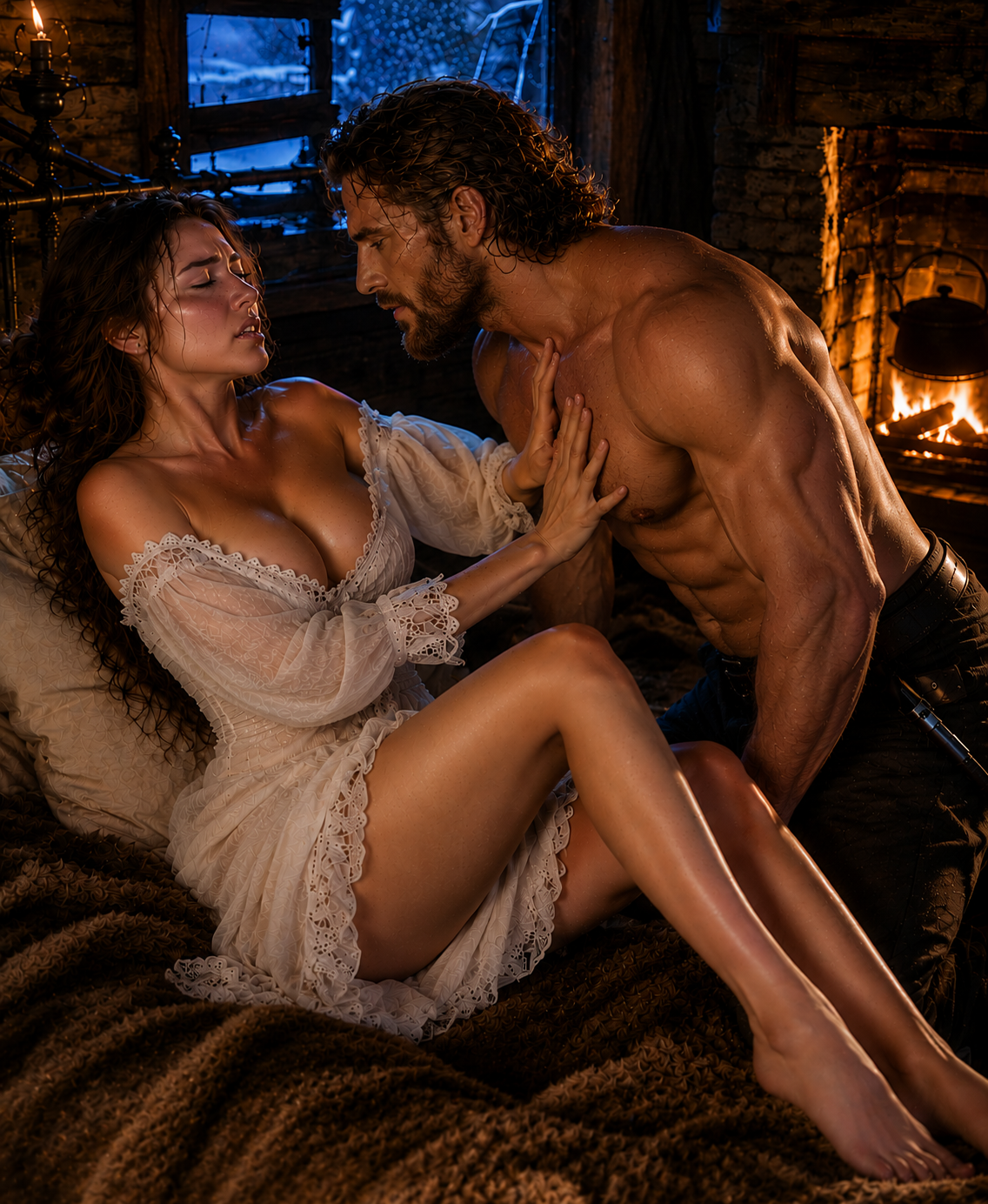
And one winter evening almost exactly a year after Lydia first arrived, snow pressed against the windows of their rebuilt cabin.
The bedroom fire burned low.
Gideon lay beside her beneath the same old buffalo robes they had rescued from the first fire.
He looked at her carefully.
“Comfortable?”
Lydia smiled.
“Yes.”
“Certain?”
“Yes.”
He still hesitated.
She touched his face.
“You can stop asking every three seconds.”
“I ask once.”
“You ask with your face.”
“Can’t help my face.”
“No. That was obvious from the station.”
He stared at her.
Then Lydia laughed.
Gideon rolled away.
“Cruel woman.”
She caught his shirt.
“Come back.”
He did.
Slowly.
Always slowly.
Years later, when Lydia tried to remember the exact moment she had fallen in love with Gideon Rourke, she could never decide.
Perhaps it had been when he handed her the biscuit instead of kissing her.
Perhaps when he stood between her and Briggs.
Perhaps when he told her she was free to leave.
But in her deepest heart, Lydia knew the truth.
It had started on that first terrible night.
The moment she had whispered:
“It hurts.”
The moment she had braced for anger.
And the enormous scarred stranger beside her had done the one thing no man in her past had taught her to expect.
He had listened.
Twenty-three years later, a young woman arrived at Fenwick House during another February storm.
She was nineteen.
Thin.
Terrified.
She carried one suitcase and refused to explain why she had come west.
Lydia, now gray at the temples, opened the door.
Behind her, Gideon was repairing a chair beside the stove.
The girl looked from his massive frame to Lydia.
“I was told women can stay here.”
“Yes.”
“What does it cost?”
Lydia understood the question beneath the question.
She had asked it herself once.
What will be expected?
What will I owe?
Who will own me afterward?
Lydia stepped aside.
“Dinner is at six,” she said. “Work is optional for the first week. Your bedroom locks from the inside.”
The girl stared.
“That’s all?”
“That’s all.”
Tears filled her eyes.
Lydia handed her a warm biscuit.
From across the room, Gideon watched and smiled.
Outside, the mountains were white and endless.
Inside, the fire burned bright.
Above the door hung a small brass loom shuttle.
Scratched along one edge.
Carved beneath the metal casing were two letters:
L.F.
Most visitors assumed it represented Lydia Fenwick.
Only Lydia and Gideon knew it had once represented something else.
Fear.
Escape.
A life she believed she had lost.
Now it hung above a doorway through which hundreds of women had passed into safer futures.
One evening their eldest daughter asked why Lydia kept such an ugly little object in the finest building on the property.
Lydia smiled.
“Because sometimes the thing you think proves your worst day…”
She glanced toward Gideon.
He was older now.
Beard mostly silver.
Shoulders still broad.
Broken nose still crooked.
He caught her looking at him.
“What?”
“Nothing.”
He narrowed his eyes.
She smiled and finished:
“…turns out to be the key to your best life.”
Gideon grunted.
“That sounds too poetic.”
“You married me.”
“Against my better judgment.”
“You fed me first.”
“You looked hungry.”
“I was.”
“You still are.”
Lydia laughed.
Then Gideon reached across the table.
He did not grab her hand.
He simply placed his palm there.
Waiting.
After all these years, he still waited.
Lydia slipped her fingers into his.
Outside, snow began falling over Black Elk Pass.
Inside Fenwick House, women laughed downstairs.
A baby cried somewhere near the kitchen.
Mara was arguing with Sheriff Cole over a missing receipt.
Someone was playing a badly tuned piano.
The world was loud.
Messy.
Alive.
Lydia looked down at the silver ring Gideon had given her all those years ago.
It had been too large then.
Now it fit perfectly.
Not because her hands had changed.
Because she had.
The woman who once crossed the country believing kindness always carried a price had built a place where kindness was given freely.
And the frightening mountain man she had once believed might become her jailer had become the first person who ever opened a door and told her she could leave.
She had stayed.
Not because she had nowhere else to go.
But because, for the first time in her life, staying was her choice.
And perhaps that was the greatest surprise of all.