THE NAPKIN HE PICKED UP
My name is Elena Rossi. I am 24 years old. I work at Casa di Vale, and I am still, officially, the girl who drops things.
It was my third night. Not third week. Third night. That is an important distinction because on your third week, people expect you to know where the extra napkins are. On your third night, you are still trying to remember which door is the kitchen and which one is the closet where we keep the vacuum that never works.
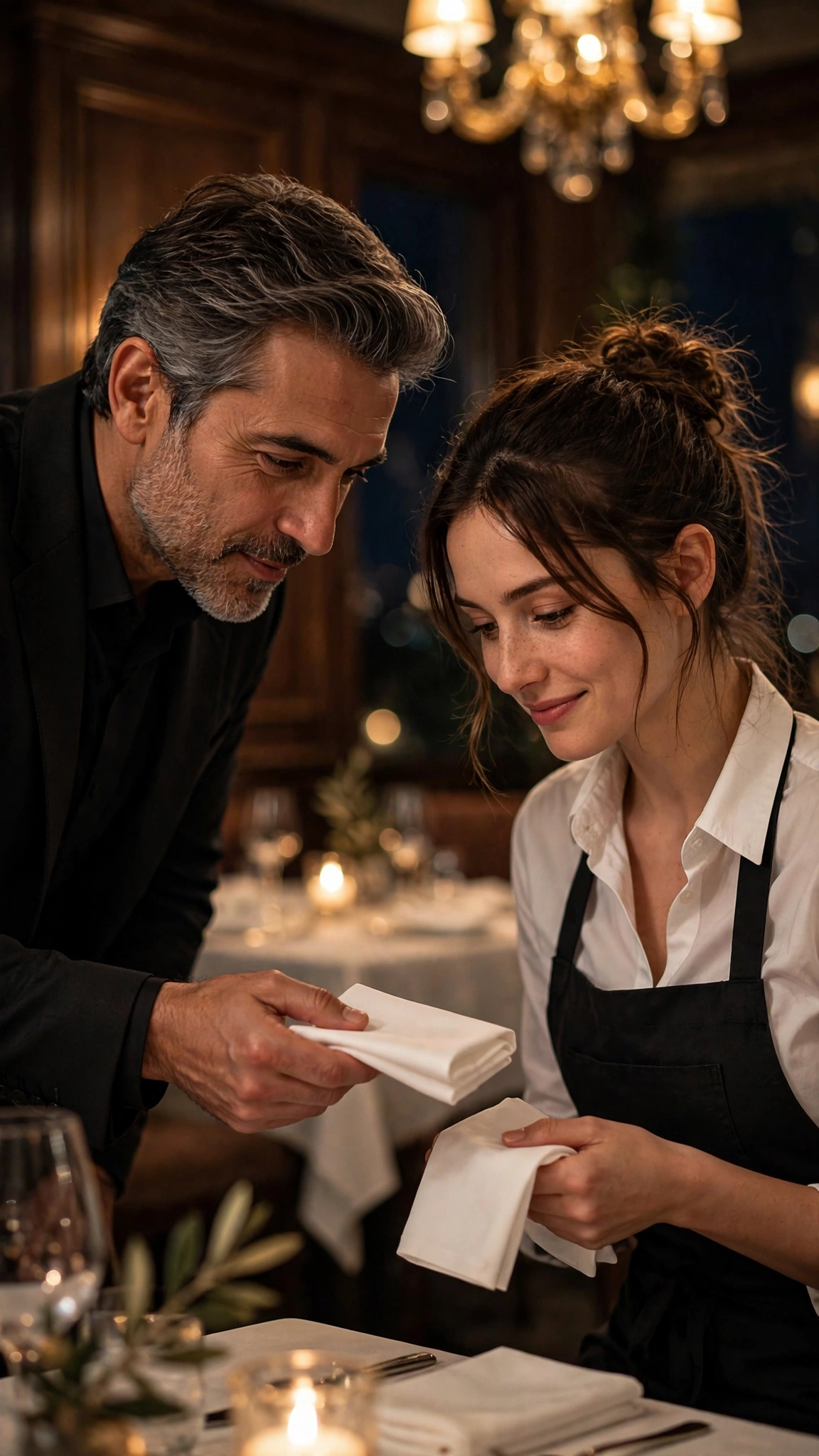
I was on side-work before service. In a restaurant like ours — luxurious, golden chandelier light, dark wood walls that make you feel like you are inside a jewelry box, soft candles on every table that make everyone’s skin look beautiful — setting the table is not just setting the table. It is a ceremony.
Marco, our floor manager, had shown me once. One white tablecloth, no wrinkles. One charger plate, exactly one inch from the edge. One fork to the left, knife to the right, blade in. Spoon next to it. One water glass, one wine glass, both polished until you can see your soul in them. And then the napkin. The perfect, clean, white, pressed napkin, folded into a simple rectangle that looks simple but has to have perfect corners or the senior servers will redo it when you are not looking.
I was setting Table 7. His table.
Signor Alessandro Vale. 42. Calm presence. Salt-and-pepper hair, always neat. Kind, intelligent eyes that never seem to be in a hurry. Black jacket. Soft-spoken and attentive in a way that makes you want to be more attentive yourself. He comes in alone sometimes, early, before the dinner rush, just to have a coffee and read. He doesn’t act like he owns the place, even though everyone knows his family does.
I had finished Table 6 without incident, which for me was a victory. I moved to Table 7 with a small stack of fresh napkins pressed against my chest like they were important documents. I was trying to do the fold Marco taught me.
And then it happened.
A clean white napkin slipped from my fingers. It didn’t fly. It didn’t make a scene. It just… slid. Softly. Silently. Like a feather. And landed on the floor, which had just been mopped, but still — floor is floor. In Casa di Vale, a napkin that touches the floor is dead. You don’t pick it up and use it. You get a new one.
I felt that hot rush of embarrassment climb up my neck. The thing about being new and a little flustered is that you apologize to objects. You apologize to the air.
“Sorry…” I whispered, mostly to myself, and I quickly bent down to pick it up.
I was halfway down, my messy bun falling over one eye, my black apron getting crooked, when I realized I was not the only person bending down.
Alessandro had leaned down at the same time.
He was sitting at Table 8, which was already set, having his espresso. He could have pretended not to see. Most guests would have. Most guests don’t want to watch the new waitress be clumsy. But he didn’t pretend.
He reached first — not fast, not to show me up — just naturally, like his body decided before his mind did. His hand picked up the white napkin from the dark wood floor. He held it out to me.
“Here.”
One word. Just “Here.” Soft-spoken. No pity in it. No “Oh, let me help the poor little waitress.” Just… here. As if we were two people picking up the same thing at the same time.
I froze for a second. My hand was in mid-air. His hand was holding the napkin I had dropped. His fingers were clean, his nails trimmed, his wrist with a simple silver watch. I had never been that close to him before. Up close, his kind eyes had little lines around them, and his salt-and-pepper hair was more salt than pepper at the temples.
I took it carefully. My fingertips barely brushed his. I could feel how soft the napkin was even through the embarrassment.
“Thank you. I’m still getting used to everything,” I said. It was the most honest thing I had said all day. I wasn’t just getting used to napkins. I was getting used to the quiet, to the chandeliers, to remembering which glass is for Barolo, to not being scared every time I approached a table.
He didn’t stand up right away. He stayed leaning slightly, at my eye level. He studied my face for a moment. Not unkindly. Not in a way that made me feel judged or looked over. More like he was trying to place me, or trying to understand why I was so hard on myself.
“It’s only your first week, isn’t it?” he asked.
I nodded, a little shy, clutching the fallen napkin now in a ball in my hand. “Third night, actually.”
I thought he would laugh. Third night sounds so small when you say it out loud in a place that has been here for forty years.
He didn’t laugh. A gentle smile formed on his face. The kind of smile that starts in the eyes before it reaches the mouth.
“You’re doing better than you think.”
You are doing better than you think.
I don’t know if anyone has ever said that to me before. People say “you’ll get there” or “don’t worry” or “practice makes perfect.” Those are all future sentences. They put you somewhere else, somewhere you are not yet. But “you’re doing better than you think” is present. It says: right now, in this moment where you are kneeling on the floor holding a dirty napkin, you are already doing better than the terrible version you have of yourself in your head.
I felt my expression soften. I could feel it happening, like a muscle unclenching. My shoulders dropped. The death-grip I had on that napkin loosened. A real, quiet smile came out. Not the practiced server smile. My smile.
I was holding the napkin. He was looking at me with calm warmth. The golden restaurant lighting made everything soft around us. The candles flickered. Somewhere behind us, Luca was polishing glasses and Marco was checking reservations.
In that tiny exchange — a dropped napkin, a hand picking it up, four sentences — I learned something about this job that no training manual had taught me.
In fine dining, we are taught that nothing should ever fall. That perfection is the standard. That the guest should never see the effort. But the truth is, things fall. Napkins fall. People trip. We bring the wrong glass. We forget the bread. We are human in a place that tries very hard to look flawless.
And the difference between a bad night and a good night, between a restaurant that feels cold and one that feels like home, is not whether something falls. It is who picks it up, and how.
He picked it up like it was nothing to be ashamed of. He picked it up like we were on the same side of the table.
I stood up, went to the laundry bin, dropped the fallen napkin in, and got a fresh one. When I came back, Table 7 was perfect. Corners sharp. Napkin folded exactly right. I set it down and I swear I did it better than I had done any other table.
When I looked up, Alessandro had returned to his espresso. But he glanced over and gave me a small nod. Like, well done.
I carried that nod with me through the entire dinner service. I didn’t drop another thing that night. Not a napkin, not a fork, not a glass. I moved a little slower, breathed a little deeper. Whenever I felt that flustered feeling come back — when Table 4 wanted extra olives and Table 9 wanted no olives and both told me at the same time — I remembered: you’re doing better than you think.
Later, after service, I was folding napkins with Sofia, another waitress who has been here for five years and can fold a napkin into a swan with her eyes closed.
“You know Vale never helps set tables,” she said, watching me.
“He didn’t help set,” I said. “He just picked up what I dropped.”
Sofia smiled knowingly. “That’s his thing. He picks things up. Last winter, a busboy slipped with a tray of oysters. Vale stood up and helped him pick up every single shell. Didn’t want anyone to step on them.”
I thought about that. About a distinguished guest in a black jacket kneeling on the floor for oysters, for a napkin.
Some people come to restaurants like this to be served. To be above everything. To watch other people work. And some people come and, even when they are the guest, they remember what it feels like to be the person who is trying so hard not to mess up.
I kept the story to myself for a long time. Because it is such a small story. A napkin fell. A man picked it up. Big deal. But in my life, in my third night, it was a big deal. It was everything.
If you are reading this and you are on your third night of anything — a new job, a new city, a new relationship, a new version of yourself that doesn’t quite fit yet — and you keep dropping napkins, literally or metaphorically, I want you to hear what he told me, and I want you to believe it because I am telling you now:
You’re doing better than you think.
You really are.
My name is Elena Rossi. I’m 24. I still get flustered. My bun is still messy. But my tables are getting better. And I now always carry an extra napkin in my apron pocket. Just in case.
And just in case you are wondering, I washed that dropped napkin myself. It’s the one I use to practice folding at home. It has a small ink stain on the corner now from where my pen leaked. Perfectly imperfect. Like me.
#TheNapkinHePickedUp #CasaDiVale #WaitressDiaries #ThirdNight #KindnessInTheDetails #ElenaRossi #FineDiningLife #SmallMoments #YouAreDoingBetterThanYouThink #StoryTime